
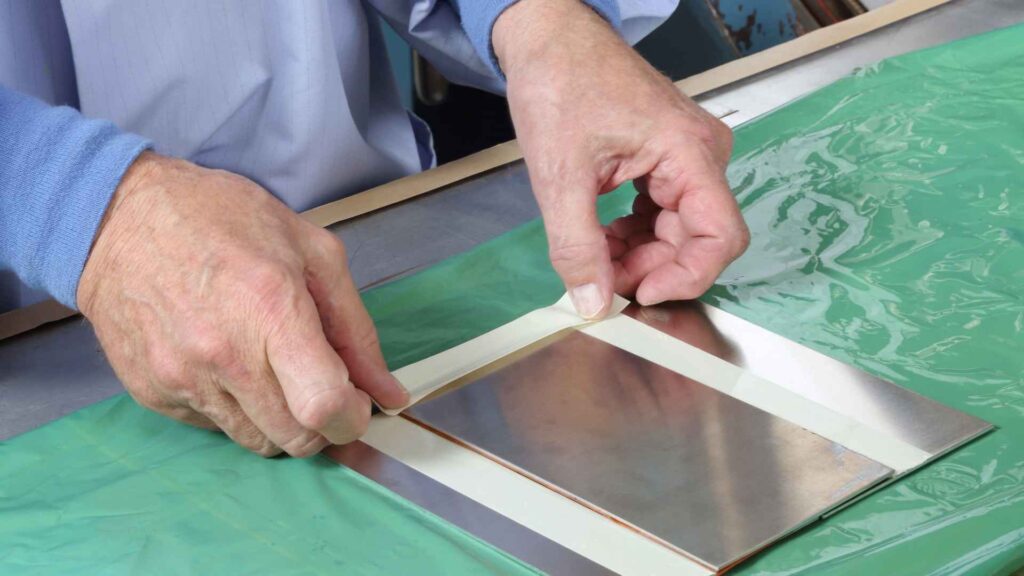
In industry, mechanical assembly using screws or rivets is a long-standing solution. However, these methods have limitations in terms of aesthetics, corrosion, and productivity. 3M adhesive tape is today a credible alternative for many structural bonding applications. But can it truly replace mechanical fastening? Here is a complete analysis of the benefits, limitations and best practices.
Why replace screws and rivets with 3M adhesive tape?
Mechanical assembly creates stresses: drilling, weakening of materials, risk of galvanic corrosion and increased assembly time.
Conversely, a 3M adhesive tape permit
-
A drill-free assembly
-
A uniform distribution of stresses
-
An aesthetic improvement
-
A reduction of labour costs
replacement of traditional fasteners with a 3M adhesive tape fits into a logic of industrial optimisation and modernisation of processes.
How does a 3M adhesive tape work in a structural assembly?
Principle of accession
A 3M adhesive tape high performance (notably the VHB ranges or acrylics technical) works by:
Chemical bonding
Surface mooring
High internal cohesion
Absorption of dynamic stresses
Unlike a screw which concentrates forces at a point, the 3M adhesive tape distributes the load over the entire bonded surface.
Practical applications for fastener replacement
Automotive industry
- Fixing bodywork elements
- Assembly of composite panels
- Glazing and accessory fixation

Electronics and domestic appliances
- Screen and component fixation
- Deformation-free assembly of thin materials
- Vibration management

Construction and facades
- Installation of decorative panels
- Fixing aluminium profiles
- Signage applications


Advantages of 3M adhesive tape over screws and rivets
-
Reduction in assembly time
-
Drilling operations removal
-
Reduction of indirect costs (tooling, maintenance)
-
Best fatigue resistance
-
Waterproofing improvement
-
Vibration absorption
-
Best aesthetic finish
-
Multi-material compatibility (aluminium, steel, plastic, composites)
Le 3M adhesive tape also allows for a reduction in total weight, which is particularly strategic in transport.
The limits: when mechanical fastening remains relevant
Extreme charges
For very high purely structural loads (bridges, heavy steel structures), mechanical fixings remain necessary.
Prolonged extreme temperatures
Certain conditions exceeding the thermal limits of adhesives require hybrid solutions.
Poorly prepared surfaces
A high-performing collage requires:
Degreasing
Cleaning
Sometimes an adhesion primer
Poor preparation compromises the effectiveness of Adhesive tape.
Regulatory constraints
Certains secteurs imposent des fixations mécaniques pour des raisons normatives.
3M adhesive tape and adhesive converting: a strategic lever
Le adhesive converter allows products to be adapted 3M to specific industrial constraints
Complex technical forms
Pre-cut, ready-to-install parts
In-line production integration
The adhesive converting process improves:
Application accuracy
Repeatability
Waste reduction
Optimising throughput
Tips and best practices for replacing screws and rivets with 3M VHB tape
1. Analyse the mechanical constraints
Type of charge (shear, peel, tensile)
Environment (humidity, temperature)
Expected lifespan
2. Testing before industrialisation
A validation test is essential:
Coat test
Shear test
Accelerated ageing
3. Optimise surface preparation
Isopropyl alcohol cleaning
Contaminant removal
Roughness control
4. Adapt the design
The design must be conceived for gluing:
Sufficient surface area
Avoid peeling constraints
Promote shear efforts
5. Consider a hybrid solution
In some cases, a screw + Adhesive offers a security / performance compromise.
Replace screws and rivets with a 3M adhesive tape is a relevant strategy in many industrial applications. This solution makes it possible to improve productivity, aesthetics and mechanical performance, while reducing assembly operations.
However, each project requires a precise analysis of mechanical and environmental constraints. The use of adhesive converting allows for optimisation of industrial integration and maximisation of performance.
 Français
  English (UK)
  Polski
  Nederlands (België)
  Deutsch
  Magyar
  Română
  Čeština