


Adhesive foam

Adhesive foam for fixing, wedging and industrial insulation


Find the right adhesive tape

What is adhesive foam?

Adhesive foam is a technical material used in industrial environments to provide functions such as’assemblyof fixationof Jointage or’waterproofing, while retaining the ability to deform and absorb stress. 

Thanks to the combination of a foam and an adhesive, this solution allows for the integration of a bonding function directly into the material, without the need for complex mechanical fixings. It is particularly well-suited for applications requiring a clean, reliable, and repeatable integration into industrial processes. 

At ADDEV Materials, adhesive foam is approached as a functional component, selected and processed according to the real constraints of the applications. 


Contact ADDEV

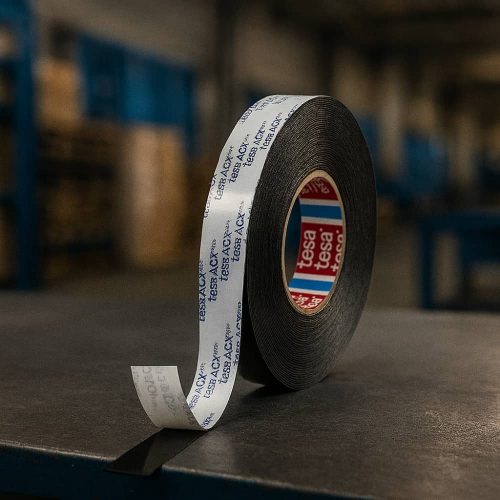
tesa ACX plus 7074
tesa ACX+ 7074
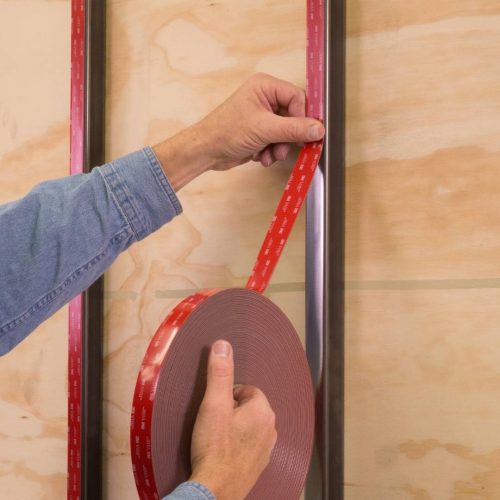
3M VHB
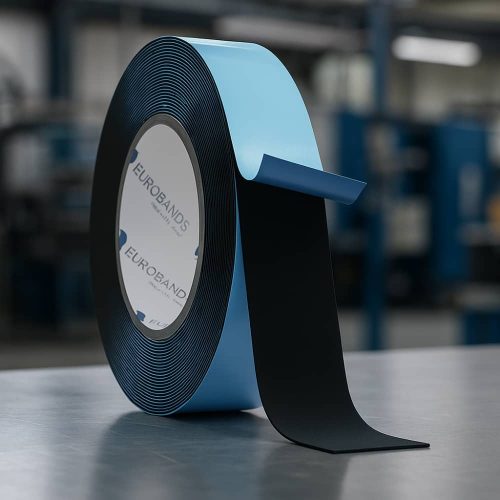
Eurobands adhesive foam


Pourquoi utiliser une mousse adhésive en assemblage industriel


The adhesive foam is preferred when the objective is to fitter, assembler or joiner components, while compensating for surface irregularities and mechanical tolerances. 

It allows: 

  • to simplify industrial gluing operations 
  • to distribute the mechanical stresses over the entire contact surface 
  • to limit vibrations and micro-movements 
  • to improve the perceived quality and perceived reliability of the assembly 

It constitutes a relevant alternative when mechanical solutions are unsuitable or when a more discreet integration is sought. 

An adhesive foam can fulfil several functions in an industrial application: 

  • Permanent or non-permanent assembly of components 
  • Functional joint between two elements 
  • Watertightness to air or to humidity depending on the configuration 
  • Amortisation Vibrations and shocks 
  • Game compensation and tolerances 

These functions can be combined, making the adhesive foam particularly versatile. 

Adhesive foams are used in many industrial applications, including for: 

  • the assembly of technical components 
  • the integration of adhesive joints 
  • the fixing of parts on irregular surfaces 
  • functional sealing in mechanical assemblies 
  • vibration reduction in assembled systems 

The choice of foam always depends on the final application and its associated constraints. 

The adhesive foam is preferred when the objective is to fitter, assembler or joiner components, while compensating for surface irregularities and mechanical tolerances. 

It allows: 

  • to simplify industrial gluing operations 
  • to distribute the mechanical stresses over the entire contact surface 
  • to limit vibrations and micro-movements 
  • to improve the perceived quality and perceived reliability of the assembly 

It constitutes a relevant alternative when mechanical solutions are unsuitable or when a more discreet integration is sought. 

An adhesive foam can fulfil several functions in an industrial application: 

  • Permanent or non-permanent assembly of components 
  • Functional joint between two elements 
  • Watertightness to air or to humidity depending on the configuration 
  • Amortisation Vibrations and shocks 
  • Game compensation and tolerances 

These functions can be combined, making the adhesive foam particularly versatile. 

Adhesive foams are used in many industrial applications, including for: 

  • the assembly of technical components 
  • the integration of adhesive joints 
  • the fixing of parts on irregular surfaces 
  • functional sealing in mechanical assemblies 
  • vibration reduction in assembled systems 

The choice of foam always depends on the final application and its associated constraints. 


Contact ADDEV

Our strategic suppliers of adhesive foams


3M logo


Tesa logo

Types of foams used for adhesive foams

PU foam


Used for interior applications requiring noise attenuation and functional integration into the assembly.

Used to fill gaps and absorb dimensional variations in environments subject to temperature fluctuations.

Suitable for applications requiring temperature resistance, sealing, and compressive strength.

Used in mechanical assembly applications requiring a good compromise between fixing and mechanical behaviour.

Used for interior applications requiring noise attenuation and functional integration into the assembly.

Used to fill gaps and absorb dimensional variations in environments subject to temperature fluctuations.

Suitable for applications requiring temperature resistance, sealing, and compressive strength.

Used in mechanical assembly applications requiring a good compromise between fixing and mechanical behaviour.

PE foam


Suitable for applications requiring vibration damping and stable performance in technical environments.

Often chosen for applications requiring durability and functional waterproofing.

Appreciated for its conformability and elongation capacity in technical assemblies.

Suitable for uneven surfaces requiring uniform contact.

Suitable for applications requiring vibration damping and stable performance in technical environments.

Often chosen for applications requiring durability and functional waterproofing.

Appreciated for its conformability and elongation capacity in technical assemblies.

Suitable for uneven surfaces requiring uniform contact.

Conversion capabilities on adhesive foams

FAQ – Adhesive Foam


What is the difference between single-sided and double-sided foam?


Single-sided foam is often used for damping or sealing, while double-sided adhesive foam is used for permanently fixing two substrates.


Yes, some versions are formulated to resist UV rays, moisture, and extreme temperatures, particularly those with reinforced acrylic adhesive.


Most technical foams are designed for permanent bonding. However, there are versions with differentiated adhesion, which are easier to reposition in the short term.


From 0.8 mm to over 10 mm, with tight tolerances. The 10 mm adhesive foam formats are the most widely used for the balance between flexibility and support.


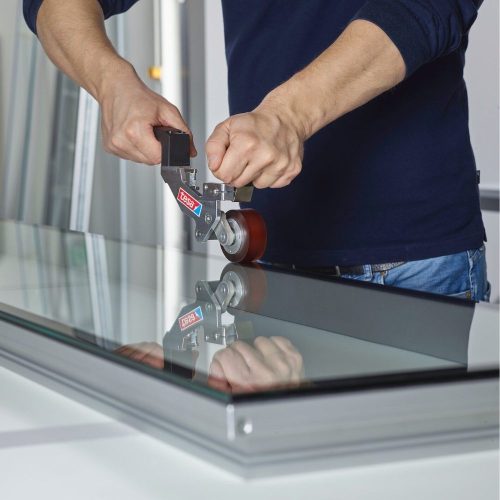
It can be supplied in rolls, tape or pre-cut discs. Manual pressure or the use of a roller is sufficient to ensure good adhesion, without the need for specific tools.