Polyurethane foam: technical solutions for industrial applications

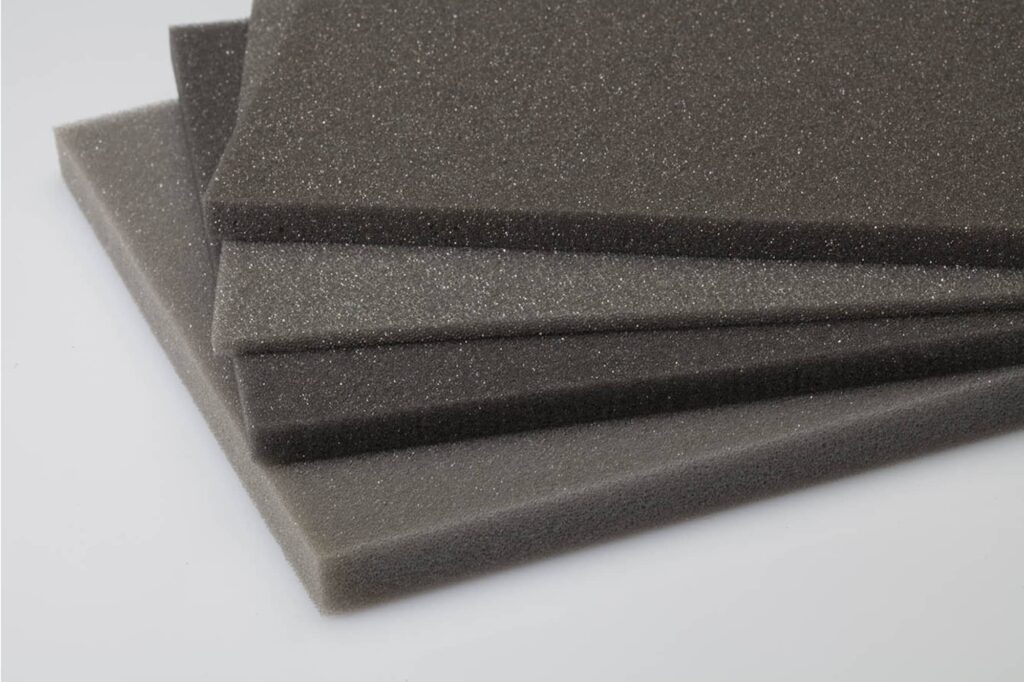
Polyurethane foam is a versatile technical material widely used in industry for its properties of conformability, sound absorption, damping and lightness. Thanks to its adaptable structure (open or closed cell), it can be used in a wide variety of applications, from noise management to protect sensitive components.

It is particularly appreciated for its ability to adapt to mechanical and environmental constraints, while offering an excellent compromise between performance and cost.

At ADDEV Materials, we support manufacturers in the customised selection, transformation and integration of polyurethane foams to optimise the performance of their systems.

Request a quote for polyurethane foam

polyurethane foam

Polyurethane foam for industrial applications

In an industrial environment, polyurethane foam is used for :

  • sound absorption
  • filtration of air or fluids
  • vibration damping
  • protection of components

It is particularly relevant in the following sectors:

  • electronics
  • railway
  • HVAC
  • energy

PU foam stands out for its versatility:

  • more flexible than PE or EPDM foams
  • better sound absorption
  • more adaptable in terms of density

It is ideal when the priority is absorption and flexibility, rather than waterproofing.

What is polyurethane foam?

Polyurethane foam (PU) is an expanded polymer with a cellular structure that can be either open or closed, offering great flexibility of use.

It is distinguished by :

  • a wide density range (≈ 32 to 400 kg/m³)
  • a excellent sound absorption
  • a good mechanical resilience
  • a high conformability

Depending on its formulation, it can be used to absorb, protect, filter or insulate.

PU foam is particularly suitable for applications requiring air permeability or noise attenuation, particularly in open cells

Supplier of polyurethane foam and custom processing

ADDEV Materials offers much more than a simple supply of materials.

We are involved at every stage:

  • selection of foam type (open or closed cell)
  • definition of technical characteristics
  • made-to-measure processing :

Our solutions enable us to deliver components that can be directly integrated into your industrial processes.

This approach enables :

  • lower assembly costs
  • improved repeatability
  • optimised overall performance

Polyurethane foam vs. other foams: What's the difference?

PU vs EPDM

  • PU → absorption, lightness
  • EPDM → sealing, external resistance

PU vs PE

  • PU → more flexible, better acoustics
  • PE → more rigid, better mechanical strength

PU open cell vs. closed cell

  • open → absorption, filtration
  • closed → insulation, waterproofing

The choice depends directly on the main function expected.

polyurethane foam

Industrial applications of polyurethane foam

Sound absorption

  • industrial noise reduction
  • cabin sound insulation
  • vibration damping

Air filtration and circulation

  • industrial air filters
  • HVAC systems
  • air flow management

Mechanical protection

  • shock absorption
  • protection of sensitive components
  • tolerance compensation

Energy and electronics

  • component maintenance
  • indirect thermal management
  • protection in batteries and electronic systems

General applications

  • assembly
  • jointing
  • sound insulation

Which industrial markets use polyurethane foam?

How to choose the right polyurethane foam

The choice depends directly on your technical constraints and your environment of use.

Density and structure (open vs closed)

Density influences :

  • mechanical strength
  • compressibility
  • sustainability

An open structure favours absorption, a closed structure insulation.

Acoustic performance

Acoustic performance depends on :

  • density
  • thickness
  • cell structure

The more open the foam, the more effective the absorption.

Environmental resistance

Depending on your application:

  • humidity
  • temperature
  • chemical stress

Some PU formulations are suitable for demanding environments.

Industrial process compatibility

It's essential to think ahead:

  • cutting
  • integration
  • assembly

The right foam improves productivity and reduces losses.

Why choose ADDEV as your polyurethane foam supplier?

ADDEV Materials has positioned itself as a technical partner:

Multi-material expertise

Technical support

International industrial presence

Advanced converting capabilities

Cost / performance optimisation

We design solutions tailored to your industrial constraints, not standardised products.

Our partner brands in technical foam

To guarantee high performance and meet the requirements of the most demanding industrial environments, ADDEV Materials relies on benchmark partners in the field of technical foams.

We work with companies renowned for their expertise and the quality of their materials:

Rogers logo
Armacell
Saint-gobain
Interep

Need polyurethane foam for your application?

Each project has its own specific constraints.

Our experts can help you with :

  • identify the right solution
  • optimise your design
  • secure your product performance

Talk to a materials expert
Receive a technical recommendation within 24 hours

FAQ - Polyurethane foam

Polyurethane foam is an expanded polymer material, available in open or closed structures, used for absorption, protection and insulation in industrial applications.


Open PU foam is permeable and used for sound absorption or filtration, while closed foam is waterproof and used for insulation.

It is used for sound absorption, filtration, mechanical protection and vibration damping.

A low density favours lightness and absorption, while a high density improves mechanical strength and durability.

Open PU foams are permeable, while closed versions offer better moisture resistance.

Open-cell polyurethane foams are the most effective at absorbing noise.

Yes, with formulations adapted to UV and environmental conditions.

Yes, it is used for filtration, airflow management and acoustic attenuation.

Yes, it can be cut, rolled and shaped to suit industrial requirements.