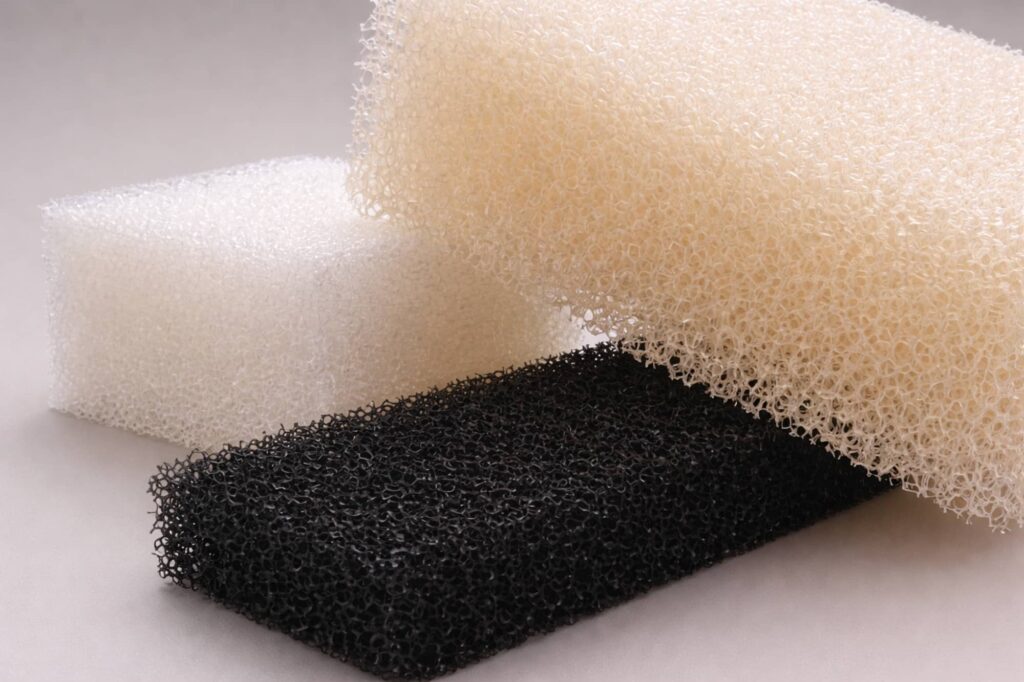
Open-cell foam is a technical material widely used in industry for its insulating properties. permeability, sound absorption and damping. Unlike closed-cell foams, it allows air and fluids to circulate, making it a key solution for applications such as acoustic management, vibration filtration or dissipation.
At ADDEV Materials, we support manufacturers in the selection, transformation and integration of technical foams adapted to their mechanical, thermal and environmental constraints, with a performance- and sustainability-oriented approach.
In an industrial environment, open cell foam is used for :
It is particularly relevant in HVAC systems, electronic equipment and confined environments.
The main difference lies in the structure:
The choice therefore depends directly on the expected function:
absorption vs sealing.
Open cell foam is an alveolar structure in which the cells are interconnected, allowing the circulation of air, gases or liquids.
This characteristic gives it :
It is mainly made from polyurethane (PU), but can also be developed in other polymers depending on application requirements.
ADDEV Materials does more than just distribute technical foams.
We operate across the entire value chain:
This approach makes it possible to respond precisely to industrial constraints and optimise overall system performance.
Our conversion capabilities enable us to deliver parts that are ready to be integrated into your industrial processes, thereby reducing assembly costs and material losses. .
The main difference between open-cell and closed-cell foam lies in their structure and functional properties.
In a nutshell:
The choice of foam depends on a number of technical parameters.
High density improves mechanical strength but reduces compressibility.
To be adjusted according to load and durability constraints.
Acoustic performance depends on :
The more open and thicker the foam, the more effective the absorption.
Some foams are suitable for :
Critical for demanding industrial applications.
It's essential to think ahead:
Unsuitable foam can have a direct impact on productivity.
ADDEV Materials is positioned as a technical partner, capable of transforming a functional need into a material solution.
Our strengths:
Multi-material expertise
Technical support
International industrial presence
Advanced converting capabilities
Cost / performance optimisation
We don't sell a product, but a solution tailored to your application.
To guarantee high performance and lasting industrial reliability, ADDEV Materials relies on a network of partners recognised internationally for their expertise in technical materials.
We select leading manufacturers to offer solutions tailored to the most demanding environments:
Each industrial application has its own specific constraints.

Our experts can help you with :
Talk to a materials expert
Receive a technical recommendation within 24 hours
Open-cell foam allows air to circulate and absorbs sound, while closed-cell foam is airtight and used for insulation or sealing.
It is used for sound absorption, filtration, damping and protection of components in industrial environments.
No, it is permeable. For waterproofing purposes, closed-cell foam is preferable.
Open-cell polyurethane foams are the most widely used for their sound absorption performance.
The density depends on the application: low for absorption, high for mechanical strength.
Yes, as long as you choose a formulation that is suitable for UV, humidity and environmental constraints.
Open-cell foams are particularly suitable thanks to their permeable structure.