ADDEV Materials
Aerospace & Defense
Healthcare & Wellness
Industry & Electronics
Power & Mobility
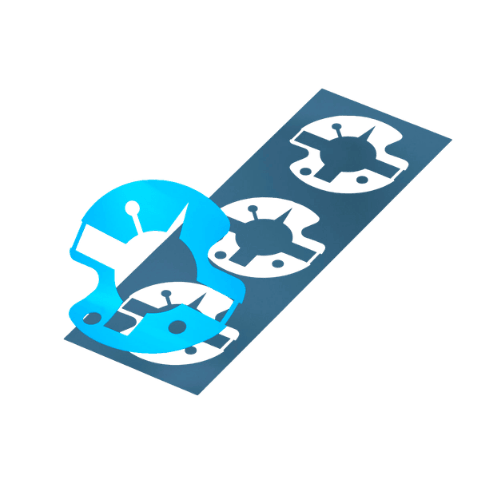
Die-cutting is an industrial process used to transform technical films and polymer materials into precision parts suitable for industrial systems.
At ADDEV Materials, this technology is used to produce components for the following applications:
Energy
Electronics
Data centres
Energy storage
Rail
Electric Vehicle
Using die-cutting, technical films can be transformed into components ready for integration into electrical, electronic or mechanical systems.
Press cutting involves using an industrial press fitted with a cutting tool to produce specific shapes in a material.
This process enables technical films to be transformed into parts adapted to assembly constraints.
For example, press cutting can be used to produce :
technical components
protection elements
insulating parts
functional elements for electronic systems
In this way, manufacturers can integrate processed materials directly into their production lines.
Die-cutting is particularly well suited to technical films used in industrial applications.
Frequently processed materials include :
PET (polyethylene terephthalate) polyester film
PEN films (polyethylene naphthalate)
polyimide films
fluoropolymer films (PTFE, FEP, PFA, ETFE)
polycarbonate films
polyolefin films
Each material has specific mechanical characteristics. As a result, the choice of press and cutting tools must be appropriate.
The ADDEV Materials teams analyse the properties of the films to ensure that they are precise, reproducible cutting.
Press cutting is used to produce parts used in a variety of industrial systems.
Cut technical films can be used in systems requiring insulation or protection.
Stamped parts can help integrate technical materials into electronic infrastructures.
Press-cutting is used to produce components suitable for compact technical architectures.
Converted films can be used to protect or insulate electronic components.
The cut materials can meet the mechanical and environmental constraints of the rail sector.
Press cutting offers a number of benefits for industrial applications.
Industrial presses are used to produce parts with controlled dimensions.
The process guarantees high repeatability for mass production.
Press-cutting can be used on a wide range of polymer materials.
The parts produced can be integrated directly into manufacturing systems.
ADDEV Materials combines expertise in materials and converting processes to support manufacturers with their projects.
Our teams are particularly active in :
selection of technical films
the design of stamped parts
optimising transformation processes
industrialisation of components
This makes it easier for manufacturers to incorporate processed technical films into their energy and mobility systems.
Industrial systems often require technical parts adapted to mechanical, thermal or electrical constraints.
The teams at ADDEV Materials support manufacturers in the processing of technical films for use in energy, electronics and mobility applications.
Press cutting is a process that uses a press equipped with a cutting tool to produce specific shapes in a material.
A wide range of technical films can be converted, including PET, PEN, polyimide, fluoropolymer and polycarbonate films.
Press cutting is used to produce precise, reproducible technical parts for industrial systems.
Yes, ADDEV Materials helps manufacturers transform technical films for energy and mobility applications.



 Français Français
  English (UK)
 Deutsch
 Polski
 العربية