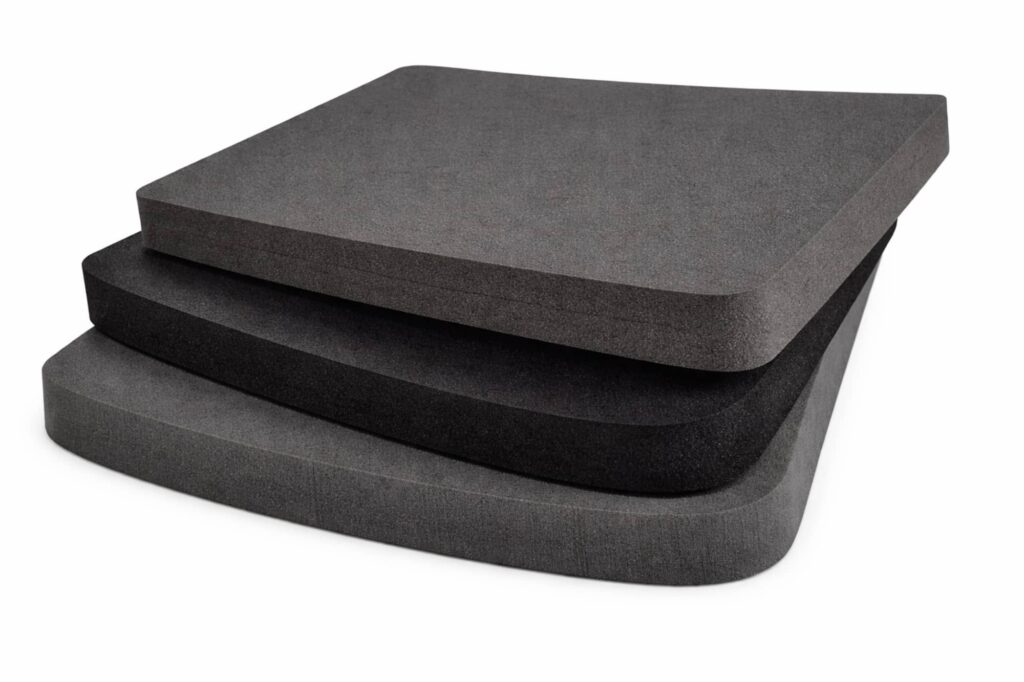
Closed-cell foam is an essential technical material for industrial applications requiring waterproofing, thermal insulation and resistance to harsh environments. Its airtight structure prevents the passage of air and liquids, making it an ideal solution for systems exposed to moisture, temperature fluctuations or mechanical stress.
Used in a wide range of sectors, including energy, rail, electronics and data centres, it ensures the reliability, durability and performance of equipment.
At ADDEV Materials, we support manufacturers in the selection, processing and integration of bespoke engineering foams tailored to their operational requirements.
In an industrial context, closed-cell foam is used for :
sealing systems (joints, sealing)
protect against infiltration (IP protection)
thermal insulation of sensitive components
absorb mechanical stress
It is essential in systems exposed to humidity, temperature variations or outdoor environments.
Closed cell foam vs. open cell foam
Closed-cell foam is distinguished by its ability to block fluids, unlike open-cell foam, which allows air to circulate.
closed cell → watertightness, insulation
open cell → absorption, permeability
The choice depends on the main function you are looking for in your application.
What is closed cell foam?
Closed-cell foam is made up of independent cells that are completely sealed from each other. This structure prevents the penetration of air, water or contaminants.
It offers key properties:
Excellent sealing (air / water / dust)
Low moisture absorption
Good thermal insulation
High mechanical resistance
The main families of materials include :
polyethylene (PE)
EPDM
PVC
Silicone
These foams are particularly well suited to harsh industrial environments where long-lasting protection is required.
Closed cell foam vs open cell foam: What's the difference?
The difference between closed-cell and open-cell foam lies in their structure and functional performance, which has a direct influence on their industrial use.
Closed cell foam
Sealed structure with independent cells
Excellent waterproofing to air, water and dust
Low sound absorption
Good thermal insulation
High resistance to harsh environments (humidity, temperature, chemicals)
Open cell foam
An interlinked structure that allows air to circulate
High permeability
Excellent sound absorption
Limited watertightness
Good shock-absorbing and filtering properties
In a nutshell
Closed-cell foam is recommended for sealing, insulation and environmental protection applications
Open-cell foam is the preferred choice for sound absorption, filtration and cushioning applications
Why choose ADDEV Materials as your closed-cell foam supplier
ADDEV Materials is positioned as a technical partner, capable of transforming a functional need into a material solution.
Our strengths:
Multi-material expertise
Technical support
International industrial presence
Advanced converting capabilities
Cost / performance optimisation
We turn your technical constraints into practical, reliable, industrialisable solutions.
Our partner brands in technical foam
To guarantee high performance and meet the requirements of the most demanding industrial environments, ADDEV Materials relies on benchmark partners in the field of technical foams.
We work with companies renowned for their expertise and the quality of their materials:
Need closed-cell foam for your application?
Each industrial application has its own specific constraints.
Closed-cell foam has airtight cells that prevent the passage of air and water, while open-cell foam is permeable and used for sound absorption or filtration.
A high density is recommended for applications requiring mechanical strength and durability, while a lower density is suitable for lightweight requirements.

 Français
  English (UK)
 Deutsch
 Polski
 العربية