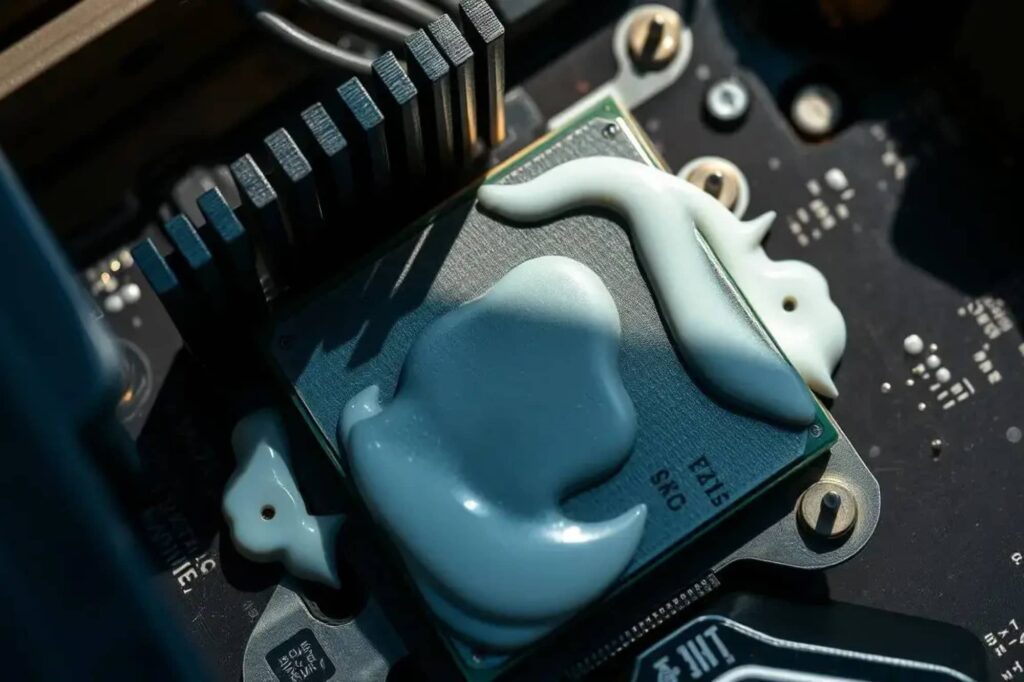
Thermal paste: heat dissipation solutions

Thermal paste is an essential solution for ensuring a Optimal heat transfer between electronic components and dissipation systems. In an industrial context marked by miniaturisation and increased power, it makes it possible to guarantee the Reliability, performance and lifespan of equipment.

Used as a thermal interface, it improves contact between surfaces by filling micro-irregularities, thereby limiting thermal losses.

At ADDEV Materials, we support manufacturers in the selection and integration of thermal pastes suited to their technical constraints, in order to optimise the thermal management of their systems.

Request a quote for thermal paste

Thermal paste

Thermal paste for industrial applications

In an industrial environment, thermal paste is used to:

  • dissipate heat from electronic components
  • improve the thermal performance of systems
  • prevent overheating
  • extend the lifespan of equipment

It is particularly used in high power density systems.

Thermal paste is distinguished by:

  • an excellent ability to adapt to surfaces
  • very low thermal contact resistance
  • a flexible application

It is preferred where surfaces have significant irregularities.

What is thermal paste

thermal paste, also known as Thermal paste, is a thermally conductive material used to improve heat transfer between two surfaces in contact.

It is characterised by :

  • a Good thermal conductivity
  • a ability to fill micro-unevenness
  • a thermal resistance reduction
  • a adaptability to uneven surfaces

It allows thermal performance to be optimised without altering the mechanical design of the systems.

Thermal paste supplier and technical support

ADDEV Materials offers a comprehensive approach for your thermal management needs:

  • Selection of suitable thermal paste (conductivity, viscosity, application)
  • Technical support in choosing solutions
  • Thermal performance optimisation

Our experts will assist you in integrating the most suitable solution for your application.

This approach enables :

  • to improve heat dissipation
  • to secure the performance of systems
  • to extend the lifespan of equipment

Thermal management is a key element for ensuring the performance and reliability of electronic systems.

Thermal paste vs. other solutions: What's the difference?

Thermal paste is characterised by its ability to optimise thermal contact between surfaces.

Thermal paste vs thermal pad

  • thermal paste → excellent adaptation to irregular surfaces
  • thermal pad → simpler solution to integrate, but less precise

Thermal paste vs. thermal gel

  • thermal paste → better stability and performance
  • thermal gel → more flexible but less powerful

Thermal paste vs thermal pad

  • thermal paste → better contact conductivity
  • heat film → more rigid, less adaptable

In a nutshell

  • Choose one thermal paste to maximise heat transfer
  • Prioritise a thermal pad for simpler industrial integration
Thermal pads

Industrial applications of thermal paste

Energy and batteries

  • module heat dissipation
  • securing storage systems

Electronics and power electronics

  • component cooling
  • Thermal performance optimisation

Data centres

  • Thermal management of infrastructure
  • reliability improvement

Rail and transport

  • Thermal constraint management
  • equipment durability

General industry

  • Electrical equipment
  • Embedded systems
  • Applications requiring efficient heat dissipation

Thermal paste significantly improves the thermal performance of industrial systems

Which industrial markets use this product?

How to choose the right thermal paste

Thermal conductivity

Thermal conductivity is a key criterion.

The higher it is, the more effective the heat dissipation.

Viscosity and application

The viscosity influences:

  • ease of application
  • the stability of the material

Appropriate viscosity ensures good durability.

Thermal and environmental resistance

It is important to assess:

  • The temperature holding
  • stability over time
  • resistance to environmental constraints

Critique for industrial applications.

Industrial process compatibility

It's essential to think ahead:

  • application methods
  • production constraints
  • repeatability

A tailored solution improves quality and productivity.

Why choose ADDEV as a thermal paste supplier

ADDEV Materials is a technical partner in thermal management:

Multi-material expertise

Technical support

International industrial presence

Advanced converting capabilities

Cost / performance optimisation

We help you secure the thermal performance and reliability of your systems.

Need thermal paste for your application

Each thermal application has its own specific constraints.

Our experts can help you with :

  • identify the right solution
  • optimise your design
  • secure your performance

Talk to a materials expert
Get a personalised quote

FAQ – Thermal paste

Thermal paste is a heat-conducting material used to improve heat transfer between two surfaces.

It allows heat to be dissipated, overheating to be avoided, and the lifespan of equipment to be improved.

It depends on the thermal power of your application. The higher it is, the more efficient the transfer.

The paste offers better adhesion to surfaces, while the pad is simpler to integrate.

It is applied between two surfaces to improve thermal contact.

Appropriate viscosity ensures good hold and even application.

It is designed to withstand high temperatures suitable for industrial electronic applications.

It is used in electronics, energy, data centres and rail.

Yes, it is widely used to optimise the thermal management of industrial systems.