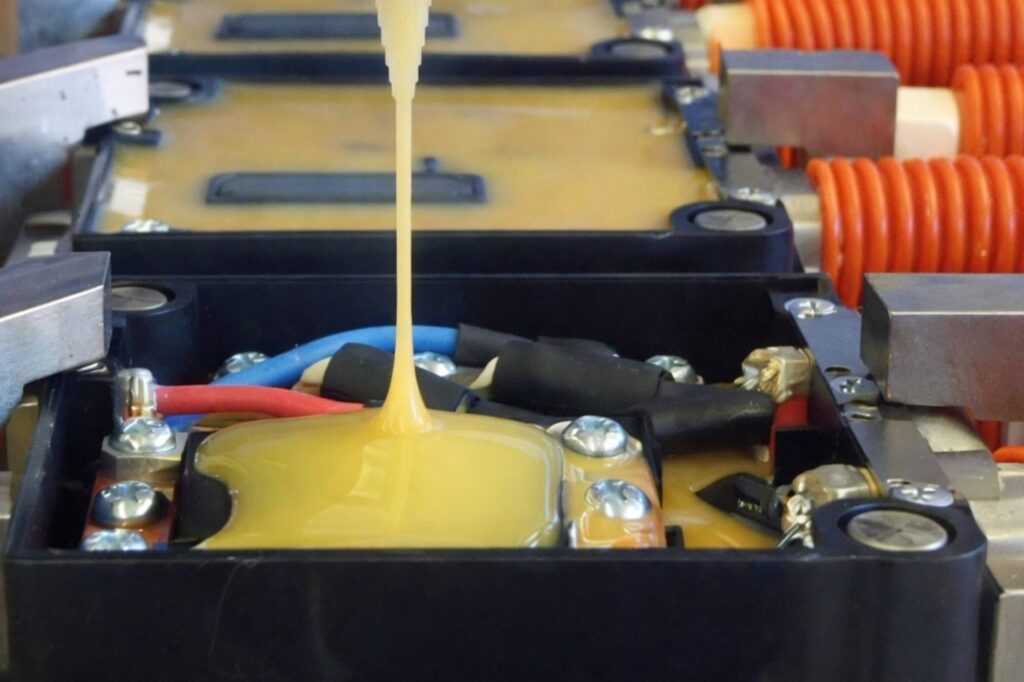
Silicone resin: encapsulation and protection solutions

Silicone resin is a benchmark technical solution for industrial applications requiring high temperature resistance, durable flexibility and optimal component protection. It is particularly used in demanding environments where thermal, electrical, and mechanical constraints are high.

Thanks to its stability and ability to absorb stress, it helps to guarantee the reliability, safety and life span of electronic and electrical systems.

At ADDEV Materials, we support manufacturers in the Bespoke selection and packaging of silicone resins, in order to optimise their performance and integration into processes.

Discuss your silicone resin needs with an expert
Receive a technical recommendation

Potting resin

Silicone resin for industrial applications

In an industrial environment, silicone resin is used for:

  • The encapsulation of electronic components
  • the potting of sensitive systems
  • shock and vibration protection
  • electrical insulation

It is particularly suitable for applications requiring high thermal resistance and flexibility.

Silicone resin is distinguished by:

  • better thermal resistance than epoxy
  • greater flexibility than polyester
  • a better fit for environmental constraints

It is privileged in extreme environments.

What is silicone resin

The silicone resin is a thermosetting polymer used for its properties of thermal resistance, flexibility and environmental protection. It is particularly suited for applications requiring stability under extreme conditions.

It is characterised by :

  • a excellent high-temperature resistance
  • a High flexibility
  • a resistance to environmental stresses
  • a Good electrical insulation

It is ideal for electrical and electronic applications requiring reliable protection

Silicone resin supplier and custom processing

ADDEV Materials offers a comprehensive approach:

  • Selecting the right resin for your application
  • bespoke packaging
  • Bespoke packaging
  • technical support

Our solutions enable us to meet the most specific industrial requirements.

Thanks to our capabilities:

  • adaptation to production constraints
  • Improved reproducibility
  • optimisation of application conditions

Resins can be custom formulated to meet the specific needs of industrial applications.

Silicone resin vs. other resins: What's the difference?

Silicone resin is positioned as a high-performance solution for extreme environments.

Silicone resin vs. epoxy

  • silicone → high thermal resistance, flexibility
  • Epoxy resins are a class of thermosetting polymers that are widely used in various applications due to their excellent mechanical properties, chemical resistance, and adhesive qualities. Here's a breakdown of "rigidité" and "résistance mécanique" in the context of epoxy: **Rigidité (Rigidity)** In the context of epoxy, rigidity refers to its stiffness and resistance to deformation under stress. A rigid material will maintain its shape and not bend or flex significantly when a force is applied. * **Young's Modulus:** This is the quantitative measure of a material's rigidity in the elastic deformation range. A higher Young's modulus indicates greater rigidity. Epoxy resins typically have a high Young's modulus, contributing to their use in structural applications. * **Dimensional Stability:** Rigid materials tend to have good dimensional stability, meaning they don't change shape or size easily with temperature fluctuations or under load. This is crucial for applications where precise dimensions are required. **Résistance Mécanique (Mechanical Strength)** Mechanical strength is a broader term that encompasses several aspects of how a material behaves under various types of stress. For epoxy, this includes: * **Tensile Strength:** The maximum stress a material can withstand before breaking when stretched or pulled. Epoxy resins generally exhibit good tensile strength. * **Compressive Strength:** The maximum stress a material can withstand before failing under compression. Epoxies are known for their high compressive strength. * **Flexural Strength:** The ability of a material to resist bending. While rigid, some epoxies can also have good flexural strength, allowing them to withstand bending forces without fracturing. * **Impact Strength:** The ability of a material to absorb energy and resist fracture when subjected to a sudden blow or impact. The impact strength of epoxy can vary significantly depending on the specific formulation, curing agent, and any additives used. * **Fatigue Strength:** The ability of a material to withstand repeated cycles of stress over time without failure. **In Summary for Epoxy:** When we say epoxy has "rigidité, résistance mécanique," we mean it is: * **Stiff and Doesn't Deform Easily:** It maintains its shape under load. * **Strong:** It can withstand significant forces applied in tension, compression, and bending before failing. * **Durable:** These properties make it suitable for demanding applications where structural integrity and long-term performance are essential. The specific values for rigidity and mechanical strength will vary greatly depending on the exact epoxy resin system (e.g., bisphenol A-based, epoxy novolacs) and the curing agent used, as well as processing conditions and post-curing treatments.

Silicone resin vs polyurethane

  • silicone → better temperature resistance
  • Polyurethane → better vibration absorption

Silicone resin vs polyester

  • silicone → better environmental resistance
  • polyester → more economical solution

In a nutshell

  • Choose one Silicone resin for applications requiring High temperature, flexibility and durability
  • Consider other resins according to your specific constraints.
Industrial resin

Industrial applications of silicone resin

Electronics and encapsulation

  • protection of sensitive components
  • reliability improvement

Electrical insulation

  • circuit protection
  • System security

High-temperature environments

  • High thermal resistance
  • stability in extreme conditions

Watertightness

  • Protection against moisture and contaminants

General industry

  • Potting
  • Coating
  • System protection

Silicone resins cover a wide spectrum of applications: protection, insulation and sealing

Which industrial markets use this product?

How to choose the right silicone resin

Thermal resistance

Silicone resin is particularly suitable for high-temperature environments.

Critique for electronic and industrial applications.

Flexibility

It enables :

  • to absorb the constraints
  • to limit cracking

Essential for dynamic environments.

Chemical and environmental resistance

To be assessed according to:

  • chemical exposure
  • humidity
  • Terms of Use

Ensures durability.

Industrial process compatibility

It's important to think ahead:

  • application methods
  • production constraints
  • repeatability

An appropriate solution optimises performance.

Why choose ADDEV as your resin supplier

ADDEV Materials supports you with complete technical expertise:

Multi-material expertise

Technical support

International industrial presence

Advanced converting capabilities

Cost / performance optimisation

We help you to improve the reliability and durability of your systems.

Need resin for your application

Each industrial application has its own specific constraints.

Our experts can help you with :

  • identify the right solution
  • optimise your design
  • secure your performance

Talk to a materials expert
Get a personalised quote

FAQ – Silicone Resin

Silicone resin is a polymer used for protection, encapsulation and insulation in industrial applications.

Silicone resin offers better thermal resistance and greater flexibility.

It is used for encapsulation, potting, insulation and protection of systems.

Silicone resin is the most suitable solution for high-temperature environments.

Yes, it offers excellent flexibility and absorbs mechanical stresses.

Yes, it is ideal for electronic and electrical applications

It offers excellent durability even in harsh environments.

Yes, it can be adapted to specific industrial needs.

Yes, it offers excellent waterproofing and protection against moisture.