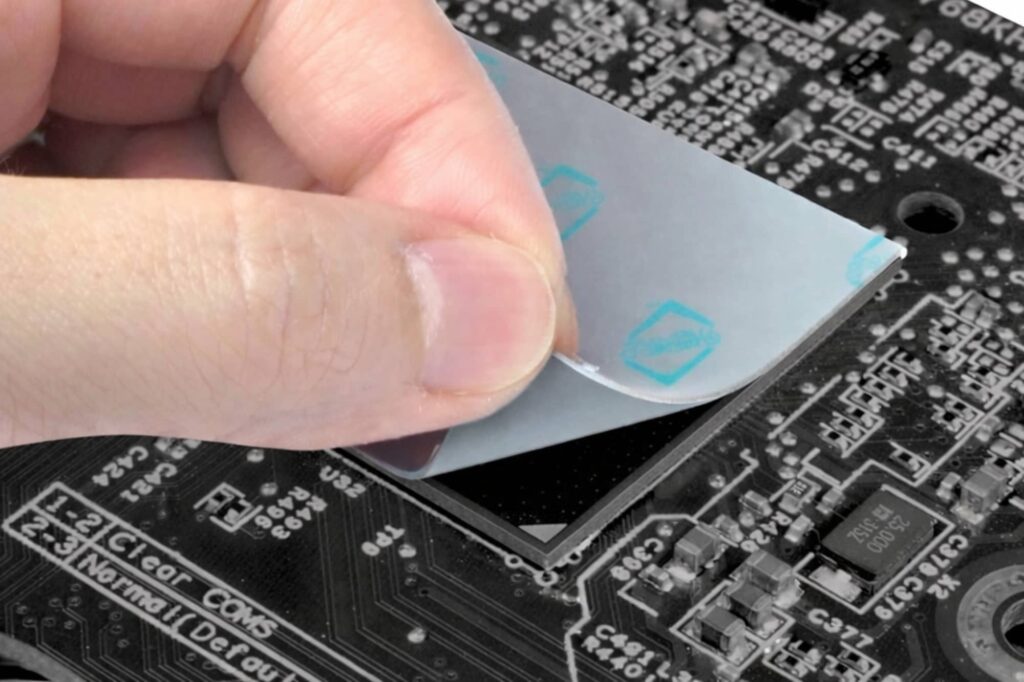
Pad silicone: thermal management solutions

The silicone pad is an essential solution for ensuring efficient thermal management of electronic components. In a context of miniaturisation and increasing system power, it makes it possible to guarantee the Reliability, performance and lifespan of equipment.

Used as a thermal interface, it ensures the transfer of heat between components and heat sinks, while compensating for flatness defects.

At ADDEV Materials, we support manufacturers in the selection and custom processing of silicone pads, to optimise thermal performance and integration into their systems.

Get quote for silicone pad

Thermal paste silicone

Silicone pad for industrial applications

In an industrial environment, the silicone pad is used for:

  • dissipate heat from electronic components
  • improve the thermal performance of systems
  • protect equipment against overheating
  • extend the life of products

It is particularly used in high power density systems.

The silicone pad offers several advantages:

  • clean, easy-to-integrate solution
  • stability over time
  • Best industrial repeatability
  • ability to absorb mechanical tolerances

It is a reliable alternative to liquid or complex solutions.

What is the silicone pad?

The silicone pad is a thermally conductive material designed to improve heat transfer between two surfaces, usually an electronic component and a heatsink.

It is characterised by:

  • a Good thermal conductivity
  • a Excellent compressibility
  • a ability to fill the gaps
  • a ease of integration

It allows heat dissipation to be optimised without resorting to complex solutions that are difficult to control.


Supplier of silicone pads and custom processing

ADDEV Materials offers a comprehensive approach for your thermal management solutions:

  • Selection of suitable silicone pad (conductivity, thickness, compressibility)
  • Thermal performance optimisation
  • made-to-measure processing :

Our industrial capabilities enable us to supply pads that are perfectly suited to your application.

This approach enables :

  • simplified integration
  • better repeatability
  • lower assembly costs

Thermal management is a key element for ensuring the performance and longevity of electronic systems.

Silicone pads vs. other solutions: What's the difference?

The silicone pad stands out from other thermal solutions due to its ease of integration and stability.

Silicone pad vs thermal paste

  • silicone pad → clean solution, easy to install, stable over time
  • thermal paste → more complex application, risk of performance variation

Silicone pad vs liquid gap filler

  • ready-to-use silicone pads
  • liquid solution → more complex and less reproducible process

Silicone pad vs thermal film

  • silicone pad → best adaptation to irregular surfaces
  • thermal film → stiffer, less forgiving

In a nutshell

  • choose one Silicone pad for a reliable, clean and industrial solution
  • prioritise other solutions only if your application imposes specific process constraints
Thermal pads

Industrial applications of silicone pad

Energy and batteries

  • module heat dissipation
  • safety of energy storage systems

Electronics and power electronics

  • Component cooling
  • Thermal performance optimisation

Data centres

  • Thermal management of infrastructure
  • improved system reliability

Rail and transport

  • resistance to thermal stress
  • Safety and durability of equipment

General industry

  • Electrical equipment
  • Embedded systems
  • applications requiring reliable thermal management

The silicone pads ensure efficient thermal conductivity of several W/m.K and can withstand high temperatures, up to around 200°C.

Which industrial markets use this product?

How to choose the right silicone pad

Thermal conductivity

Thermal conductivity is a key criterion for efficient heat dissipation.

The higher the value, the better the thermal transfer.

Thickness and compressibility

The pad must be able to :

  • compensate for mechanical tolerances
  • ensure good thermal contact

Good compressibility ensures efficient heat transfer.

Thermal and fire resistance

Depending on your application, it is essential to assess :

  • The temperature holding
  • fire resistance

Critical for demanding industrial environments.

Industrial process compatibility

It's important to think ahead:

  • integration into your production line
  • assembly constraints

An appropriate solution improves productivity and quality.

Why choose ADDEV as your silicone pad supplier?

ADDEV Materials is a technical partner in thermal management:

Multi-material expertise

Technical support

International industrial presence

Advanced converting capabilities

Cost / performance optimisation

We help you optimise the thermal performance and reliability of your systems.

Need silicone pads for your application

Each thermal application has its own specific constraints.

Our experts can help you with :

  • define the appropriate solution
  • optimise your thermal design
  • secure your performance

Talk to a materials expert
Get a personalised quote

FAQ - silicone pad

A silicone pad is a thermally conductive material used to improve heat transfer between electronic components and a heat sink.

It depends on your application. The higher the thermal power, the higher the conductivity required.

The thickness must allow for filling the gaps between surfaces while ensuring good thermal contact.

The pad is simpler to integrate and more stable, while the paste is more complex to apply.

Silicone pads can withstand high temperatures, generally up to around 200°C.

You just need to position it between the surfaces to be cooled. Its compressibility ensures good contact.

Silicone pads are particularly well-suited for batteries due to their ability to efficiently manage heat dissipation.

Yes, they can be cut and adapted to fit perfectly into your application.