
The acrylic pad is a thermal management solution designed to ensure Efficient heat transfer between electronic components and heat sinks. In a context of miniaturisation and increased power, it improves the reliability, performance and lifespan of systems.
Thanks to its stability and ease of integration, it is a high-performance alternative to traditional thermal solutions, offering a good compromise between Thermal performance and cost optimisation.
At ADDEV Materials, we support manufacturers in the Selection and bespoke transformation of acrylic pads, adapted to their technical constraints and their operating environments.
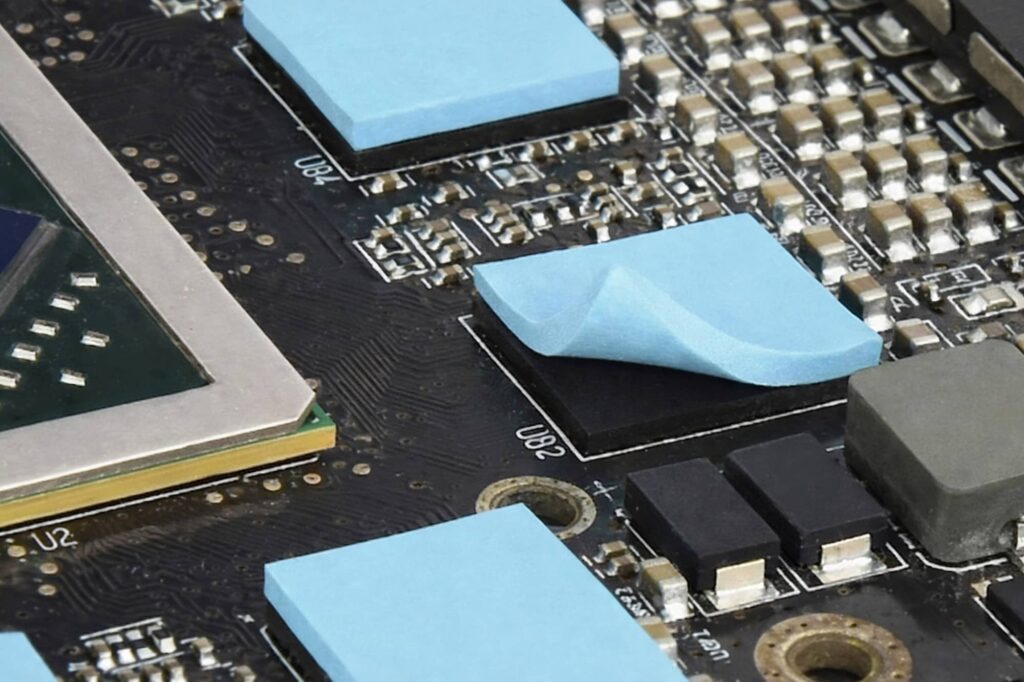
In an industrial environment, the acrylic pad is used for :
It is particularly suited for applications requiring a reliable and reproducible solution.
The acrylic pad is distinguished by :
It is a relevant alternative to liquid solutions or solutions that are more complex to manage.
Acrylic pad is a thermally conductive material used as a thermal interface between two surfaces, usually an electronic component and a heat sink.
It allows:
It is part of the thermal management solutions that are essential for maintaining the performance of electronic equipment.
ADDEV Materials offers a comprehensive approach for your thermal management needs:
Our industrial capabilities enable us to supply pads that are perfectly suited to your application.
This approach enables :
Thermal management is a key element in guaranteeing the performance and lifespan of electronic systems.
The acrylic pad offers a balanced solution between thermal performance and ease of integration.

Acrylic pads allow for effective thermal transfer while ensuring good long-term stability.
Thermal conductivity is essential for ensuring efficient heat dissipation.
It must be suited to the power of the components.
The pad must:
Good compressibility enhances heat transfer.
It is important to assess:
Critique for industrial applications.
It is necessary to anticipate:
A tailored solution optimises productivity.
ADDEV Materials is a technical partner in thermal management:
Multi-material expertise
Technical support
International industrial presence
Advanced converting capabilities
Cost / performance optimisation
We help you optimise the thermal performance and reliability of your systems.
Each thermal application has its own specific constraints.
Our experts can help you with :
An acrylic pad is a thermally conductive material used to improve heat transfer between electronic components and a heatsink.
The acrylic pad offers a good cost/performance compromise, whilst the silicone pad is more suited to extreme environments.
It depends on the thermal power of your application. The higher it is, the more efficient the transfer.
The thickness must allow for the compensation of irregularities while ensuring good thermal contact.
The pad is simpler to integrate and more stable, while the paste is more complex to apply.
It dissipates heat, prevents overheating, and improves the lifespan of equipment.
Acrylic pads can withstand high temperatures, making them suitable for standard electronic applications.
It is positioned between the surfaces to be cooled. Its compressibility ensures optimal contact.
Yes, they can be cut and tailored to fit your application perfectly.
 Français Français
  English (UK)
  Deutsch
  Polski
  العربية Français Français English (UK)
Deutsch
Polski
العربية
العربية Français Français English (UK)
Deutsch
Polski
العربية
